
From Ghost Stories to Coexistence: My Journey with Civets in Southern India


In this edition of our Meet the Researcher blog series, we hear from Dr Shameer, who is a conservationist and member of the IUCN SSC Small Carnivore Specialist Group Civet Working Group. Welcome Dr Shameer!
When people think about wildlife conservation in India, they often picture tigers or elephants.
Yet across forests, plantations, villages, and even inside our homes, another group of
mammals quietly plays a vital ecological role: civets.
For me, civets are not just a research focus. They are part of my childhood and the foundation
of my conservation journey.
Growing Up Close to Wildlife
I was born and raised in Gudalur, Nilgiris district, Tamil Nadu, close to Mudumalai Tiger
Reserve. This region is a rich mosaic of forests, tea estates, coffee plantations, and human
settlements, where wildlife was always part of everyday life. I spent much of my childhood
exploring streams, fishing, and watching birds. I was driven by a fascination with the natural world. I was especially captivated by colourful parakeets and the winter visitor, the paradise flycatcher. A large part of my childhood was spent in my grandfather’s small farmland, giving me the chance to observe nature up close.
Wildlife was also a common theme in my family stories, and my curiosity and excitement grew as I listened to tales of animals. Some were rooted in reality, others steeped in myth. I was always drawn to the beauty of wildlife. I felt like petting every colourful bird I saw and watching the attractive freshwater fish in the streams around me. These early encounters sparked a sense of wonder and curiosity that stayed with me throughout my life.
Being surrounded by such biodiversity from a young age fostered a deep curiosity about the
animals around me. Over time, this curiosity developed into a passion for wildlife biology,
eventually leading me to specialize in small carnivores, particularly those living in human-
dominated landscapes.

My First Civet Encounter
Civets are mostly nocturnal, meaning they are active at night. Because of this, they are often
heard more than seen, and in many rural areas, mysterious night sounds are sometimes linked
to myths or ghost stories.
My first civet sighting happened when I was in 7th grade. One night, a villager brought a
large animal that had been hit by a vehicle. It was an Asian palm civet. I was surprised by its
size and appearance. Until then, such animals existed for me only in stories.
Seeing it up close changed my perspective. It was not something supernatural, it was a
native wild species sharing our landscape. That moment replaced fear with curiosity and
quietly shaped my interest in wildlife.
In Nilgiri landscape, coffee plantations are common. During the fruiting season, when coffee
berries ripen into bright red fruits, a familiar visitor arrives—the Asian palm civet
(Paradoxurus hermaphroditus). While sometimes perceived as crop raiders, they even attack
poultry.

When “Ghost Sounds” Became Science
Years later, during my PhD, I had another memorable encounter with a civet. I was staying at my PhD guide’s traditional Kerala-style house, which had a wooden attic loft used for storage. His parents often heard sounds at night—light thuds and movement above the ceiling. Naturally, there was curiosity about what might be there. Instead of speculating, I installed a camera trap—a motion-activated camera used in wildlife research.
The footage revealed the visitor: a common palm civet using the attic as a resting space.
The mysterious “night presence” turned out to be a well-adapted urban survivor.
In Kerala, common palm civets are frequently found in roof spaces and attics. Even in my
own house, a civet occupies such a space. On several occasions, I have seen it moving across
the attic floor or running outside at night.
This is coexistence in its most direct form—wildlife living quietly alongside us.

My Research on Small Carnivores in India
I study a variety of small carnivores in Tamil Nadu, focusing on lesser-known species like
jackals, foxes, and pangolins. Most of their habitats lie outside protected areas, where they
face threats such as habitat loss, poaching, killing, and road accidents. My work aims to
identify and prioritize critical habitats to guide conservation programs.
Many other species, including civets, mongooses, and wild cats, also face significant threats
but receive little conservation attention. I aim to develop action plans for these species to
ensure their long-term survival.
Earlier, I studied the brown palm civet, an endemic species of the Western Ghats, and found
that rainforest destruction and habitat fragmentation pose serious threats to its survival.
Similarly, for the vulnerable Nilgiri marten, much of its range overlaps with tea, coffee, and
timber plantations, highlighting the importance of conserving non-protected areas adjacent to
reserves.
I have also worked on three mongoose species: the ruddy mongoose, stripe-necked
mongoose, and brown mongoose. I worked on providing baseline data on their spatiotemporal patterns, which help in understanding the complex community ecology of the Western Ghats.
In the Godavari Delta, my research on the fishing cat shows that this region is a key
landscape for long-term conservation. We found that fishing cats show high temporal overlap
with rodents but avoid human disturbances, suggesting that reducing anthropogenic stress is
essential for sustaining populations in human-dominated landscapes.
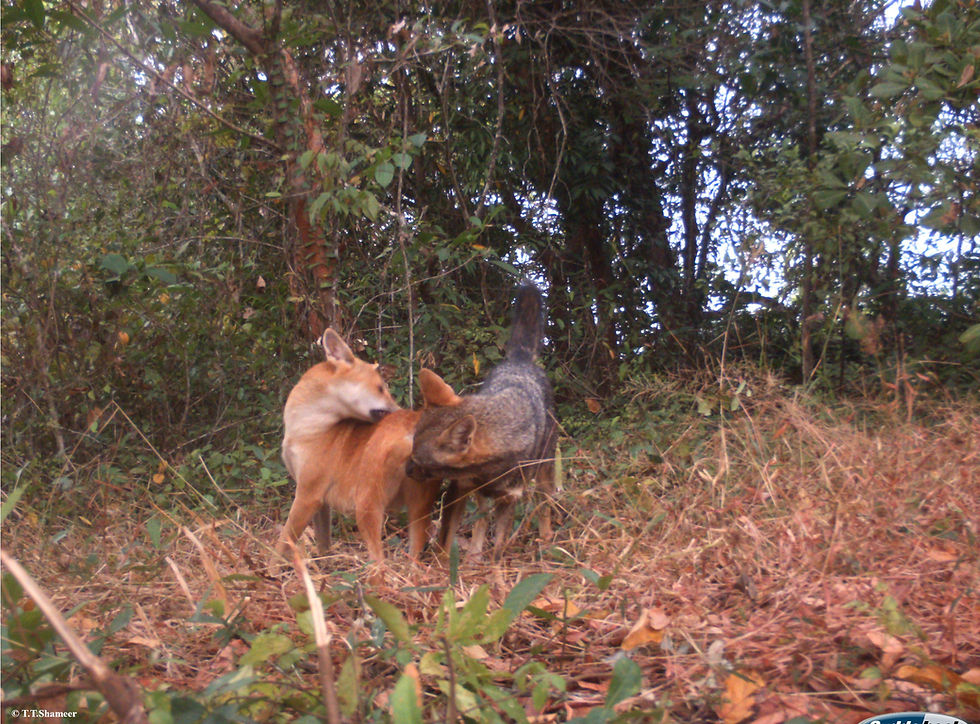
My studies on golden jackals along the southern Western Ghats coastline revealed fascinating
coat colour variations, including melanism, leucism, and rusty coats. These patterns may result
from hybridization with free-ranging dogs, which poses a potential conservation threat to
these populations.
At various stages of my research, I observed that some small carnivores are hunted and
consumed as food by local communities, which further threatens them. This highlights the
critical need to raise awareness of the ecological importance of these species and the urgency
of their conservation.
As a member of the IUCN SSC Small Carnivore Specialist Group Civet Working Group, I
contribute to the Red List assessment for the Asian palm civet, assisting in evaluating its
conservation status. Additionally, I actively organise awareness programmes for the public
and government officials to promote civet conservation. Through these efforts, I aim to
establish long-term conservation initiatives that combine research, outreach, and community
involvement to guarantee the survival of these species.


Comments